
Bugpin vs. Standard Tattoo Needles: What’s the Difference?
Bugpin tattoo needles use finer individual needles, but the label doesn’t tell you the whole size. Many suppliers call 0.25 mm or 0.30 mm needles “bugpin” and 0.35 mm needles “standard.” Others use different labels. Before choosing, compare the actual diameter, needle count, grouping and taper—not just the word on the box.
If you’re choosing between two cartridges, start with the one you already know. Keep the count and grouping the same, then compare a different diameter. That gives you a clearer starting point than changing everything at once.
Bugpin and standard sizes: check the millimeters
Here’s the diameter shorthand you’ll see in the needle-code convention used below:
| Diameter code | Individual needle diameter | What to check when shopping |
|---|---|---|
| #08 | 0.25 mm | Often sold as bugpin; check the full configuration |
| #10 | 0.30 mm | May be called bugpin or standard, depending on the maker |
| #12 | 0.35 mm | Often sold as standard; some makers use another category name |
For example, Peak’s comparison groups #08 and #10 under bugpin and #12 under standard. REBEL’s liner guide calls #08 bugpin, #10 standard and #12 power liner.
So if you’re switching brands, “standard 3RL” isn’t enough information to reorder the same specification. Look for the diameter in millimeters.
1003RL vs. 1203RL: the count stays the same
In this code format, 1003RL is a three-needle Round Liner made with 0.30 mm individual needles. 1203RL is also a three-needle Round Liner, but each needle is 0.35 mm.
The change is diameter, not needle count. Neither code gives you a guaranteed finished line width.
Compare 1003RL with 1203RL if you want to look at diameter while keeping the basic count and grouping consistent. Compare 1203RL with 1205RL and you’re changing the count instead. Those are different comparisons.
Need a refresher on the rest of the code? The tattoo needle size guide explains diameter, count and grouping separately.
Choosing bugpin or standard for your work
Use the mark or area you need to create as your starting point.
For small details or delicate line work: a finer-diameter liner is worth comparing with your current liner. Keep the count consistent first. Don’t assume a bugpin 5RL will replace a standard 3RL just because one uses thinner individual needles.
For a stronger outline: compare the diameter and full liner configuration you already use before buying a finer option. The bugpin label alone doesn’t promise the line weight you want.
For shading or filling: make sure you’re comparing the same type of grouping. A finer liner and a standard magnum change both diameter and arrangement, so the difference can’t be put down to bugpin versus standard alone.
These are ways to narrow your shortlist, not promises about ink flow or results. Taper and grouping construction still matter. If one product doesn’t list them, ask the supplier before treating it as an equivalent.
Comparing YES Needle 3RL options

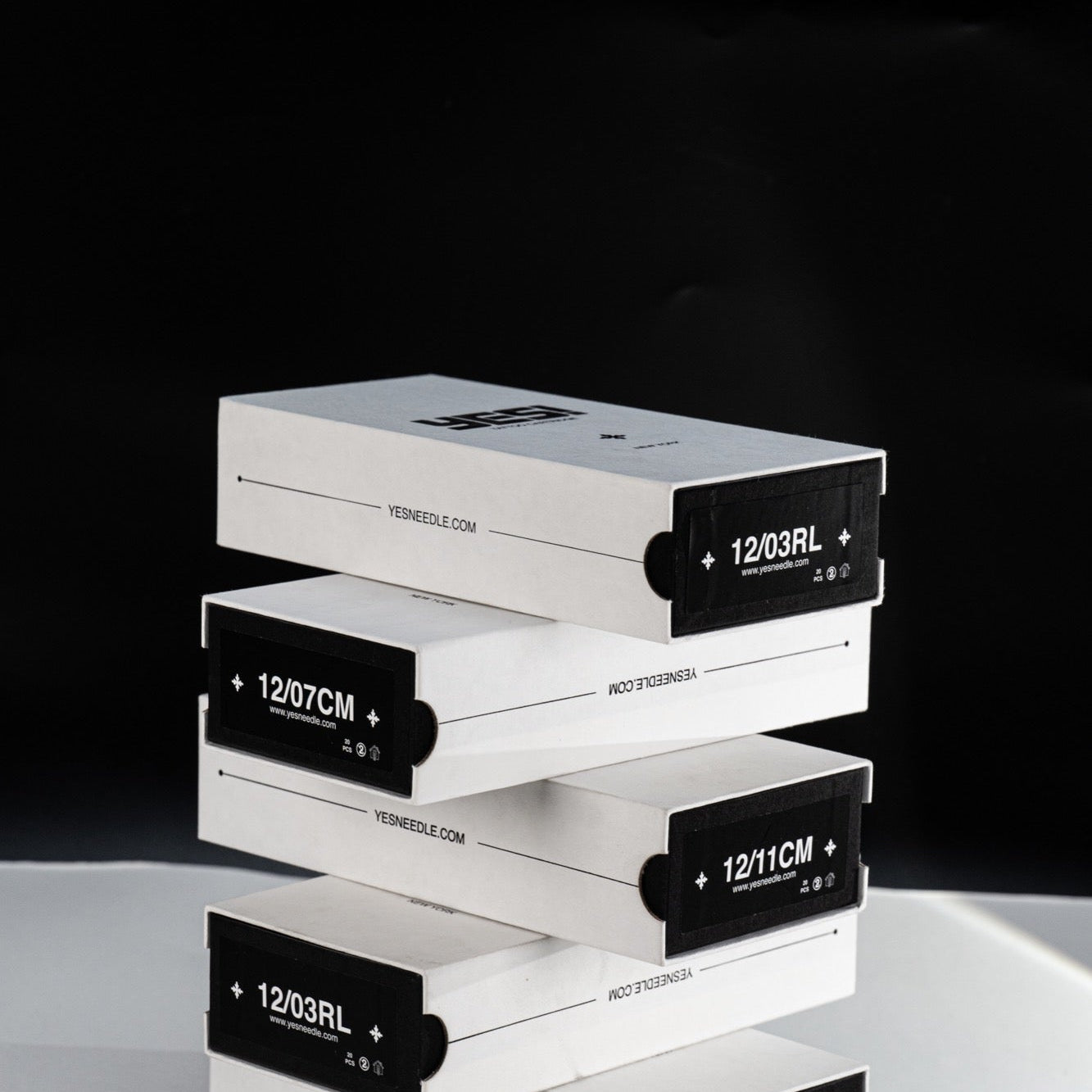
The YES Needle Round Liner range lists 08/03 RL, 10/03 RL and 12/03 RL. All three are labeled 3RL; the diameter code changes.
That makes them a practical shortlist if you want to compare finer and larger individual needle diameters without also changing the listed count. It doesn’t mean their finished lines can be calculated from the code, or that their taper and grouping tightness should be assumed identical.
When ordering, use the full variant name rather than asking only for a “bugpin 3.”
Before you switch, make the comparison useful
Write down the full code of the cartridge you already use. Then check the new option’s diameter, count, grouping and stated taper. If you’re changing brands too, note that as another difference.
For a practice comparison on a suitable practice surface, label each sample with the cartridge code and record the setup. Compare the same design element rather than unrelated marks. Practice material can help you organize a comparison; it won’t establish how a tattoo will heal on skin.
You don’t need to replace your whole stock to explore a different diameter. Start with one clearly specified alternative, keep a record of what changed, and decide whether it earns a place in your kit.
People Also Read
How Many Tattoo Cartridges Should You Stock? A Studio Reorder Worksheet
Work out what to reorder from your actual cartridge usage, usable stock and delivery window. Includes a simple worksheet for working studios.
Tattoo Needles for Color Packing: Choosing for the Space You Need to Fill
Choose color-packing cartridges around open fills, narrow corners and gradients. Compare YESNeedle M1 and CM options before ordering.
Tattoo Needles for Shading: How to Choose for Your Design
Start with the shadow in your design, then compare the grouping and count. A practical guide to narrowing down shading cartridges.
Long Taper vs. Short Taper Tattoo Needles: What Changes?
Taper describes the narrowing section of a needle. Here’s what changes—and what to check before choosing your next cartridge.